THE FARM HOUSE
Knapp-Wilson House
Built: 1860 (Construction Started), 1865 (Completed)
Architect: Milens Burt of Muscatine
Contractor: No contractor, built by day labor
The first building started on the new college land was the Farm House. Plans for it and the barn, prepared by Milens Burt, architect and builder of Muscatine, had been approved in 1859.
William G. Allen recorded that beginning:
About the year 1860, the College Farm House site was fixed by Mr. Suel Foster, of Muscatine County, and Daniel McCarthy, of Story County. Mr. Foster was one of the locating Trustees and had desired to meet Mr. E.G. Day, also a locating Trustee, on the Farm so they could select the site for the Farm House and the Barn. Mr. Day did not appear. Mr. McCarthy, I believe, had a compass and met with Mr. Foster, and they scared up a surveyor’s chain or tape line and went to work fixing the site for the house. It became the arduous duty of Esq. Daniel to drive the first stake on the Farm, looking to its improvement.1 Construction of the house was primarily by day labor but there was a contract for the stone work. The bricks used were made on the farm. (See Section on “Brickyards”)
The house is described in the 1862 Annual Report:
The brick work of a Farmers’ House, 32 by 42 feet, two stories high, with pantries and kitchen back, 16 by 24, one and a half stories, also brick, have been erected during the past two years. There is attached to this a wash-room, milk-room and wood-shed, 24 x 24, one story of wood. The back buildings were erected in 1860 and finished; the front building was put up in 1861 at a cost of $950, besides the cellar and the brick. The inside of the main building is not finished, but it is enclosed from the weather. To finish it will cost about $650. Each story is nine feet high, of good brick on solid stone walls, with a cellar under the whole of the house.
The house was not completed until 1865, In March of that year the Executive Committee reported to the Board of Trustees as follows:2
Your committee desired to have reported the Farmers House finished at this meeting. The inside carpenters work has been completed also the plastering is finished. The painting should be done immediately.
Your committee would recommend the building of a neat verandah on the front of the farm house also the building of a wood house and privy also that the outside of the farm house be coated with a composition of lime.
We have divided the cellar into three departments with brick partitions and would recommend that the bottom of the cellar be paved or cemented and that a drain should be dug from the cellar. Also that there should be new lightning rods put up to the house.
Then recorded is an itemization of expenses incurred on the building in 1864, a total of $1772.67. Another $30 was spent for a cistern of 100 barrels capacity and $99 for stoves and furniture for the office. The committee additionally recommended “that the well be rewalled and dug deeper, and to put a good wellhouse and pave around the same.”
That the recommendations of the committee were generally carried out can be seen in the Annual Report for 1865:
A beautiful verandah has been put up since our last meeting, in front of the farmhouse, at a cost of $300. It is built substantially, and it relieves the bare walls of the house, and will be a protection to it.
A wood-house and workshop has been erected, east and adjoining the back part, on the lean-to of the house. It has been built of wood and put up in a substantial manner, at a cost of $646.75. It is well painted, with blinds to the windows, with a division in the center - one part for wood-house and the other for work shop, and room for the hands to spend their leisure hours. Length of building 18 x 30 ft.
A good double privy has been built of brick, 10 x 10, in a good substantial manner, at a cost of $150.
A neat and substantial smoke and ash house has been built of brick, 8 x 12 feet, got up in a tasty style, suitable for model building, at a cost of $130.
A book case has been put into the office the entire length of the north side of the office, made of good black walnut, with cupboard and solid doors beiow the glass doors above, with room for 2,000 volumes, at a cost of $200.
The area between the wood-house and main building has been paved, making a good dry walk, at a cost of $25.
The cellar has been drained, taking about one hundred feet of four-inch tile (the small tile were used, but would not do). The cellar is now completed, drained, and in good condition, at a cost for 100 feet of tile at 25 cents per foot, of $25; cost of labor, $21.81. Total cost, $46.81.
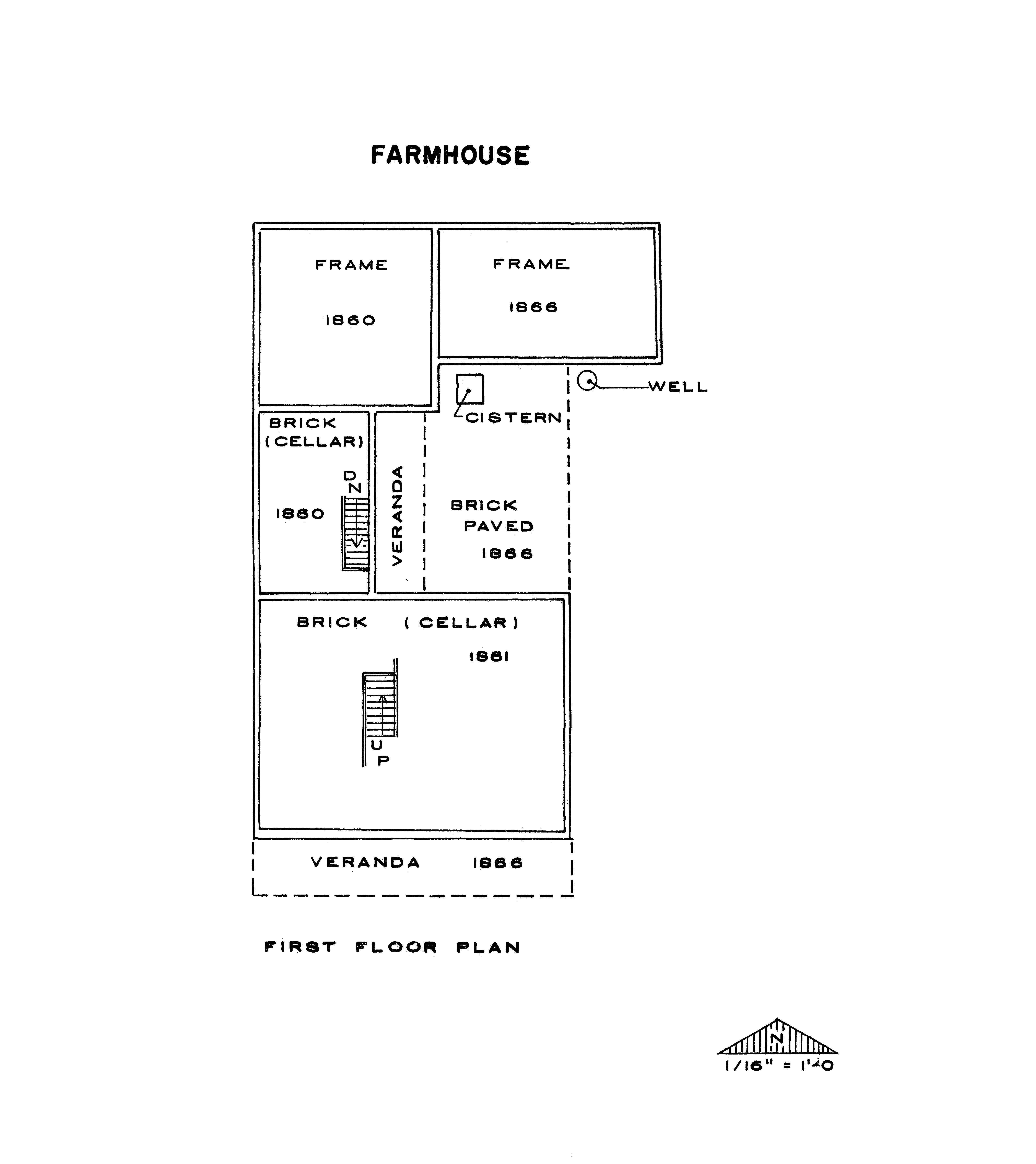
There is a sketch made by Herman Knapp (in the History Collection of the Library) showing a plan of the Farm House as it was about this period. It has been redrawn and is included here to clarify the dates when the several parts of the house were built.
In 1871 some modifications were made “to enlarge the kitchen, fix up the east wing or the secretary’s office and reporting room and to rearrange the old office for a parlor. 11 3
Maintenance of the Farm House was a continuing problem as evidence by the Superintendent’s report4 in 1877:
The farmhouse cellars were found in condition utterly unfitted for any practical use, winter or summer.
The floors have been paved with brick, the outer courses being made of hard brick, laid in cement. The walls, riddled with rat holes, were refitted and neatly plastered, as were also the ceilings. The rotted jambs and doors were refurnished, and the stairways bricked, and placed in usable shape.
This imperatively needed improvement will allow of the safe storage of potatoes and other vegetables for spring use, in place of selling such products in the fall, and buying at enhanced prices in the spring, as was done last year. The temporary use of these cellars is also kindly permitted for storing the vegetables of the Horticulture department for the spring term of school, and for the storage of stocks for winter grafting. With out this privilege, nothing could have been done in the way of commencing a nursery next spring.
The farm house roof was also found in rotted, leaky condition. The roof, in part, has been re-shingled and the balance repaired, but a new roof will be necessary on the main building next summer.
Roof repairs were made again in 1880 and 1881, and the building was reported as being greatly improved by a coat of paint (in the 1890-91 Biennial Report).
Residences for faculty were always short of demand. In 1886 it was decided to alter the Farm House to permit two families to occupy it, one on the east, the other on the west side of the central hall and stairway. The sum of $200 was appropriated in May 1887 for an addition to the building, presumably to provide for the second kitchen for a second family.
In 1896 the house was connected to the sanitary sewer line. Late that same year Professor James Wilson put in a new heating plant at a cost of $220 for which he was reimbursed the following February when he left to become U.S. Secretary of Agriculture. That furnace served until 1907 when the house was connected to the central system.
The frame portion, built as the wood-shed and workshop, was removed in 1891 to be joined with the old creamery to form the building later called the Farm Foreman’s Cottage.
The north 24 x 24 brick addition was apparently removed in 1897. At the May meeting of the Board of Trustees the Building Committee recommended “tearing down the north section of the farm house, which is but a harbinger for rats. Cost of tearing down, clearing brick and piling all up neatly $23.00.”
The May 17, 1898 issue of the I.A.C. Student reported that “the porch along the south side of the farmhouse was torn down, and is now replaced by a smaller one.”
The Board Minutes of October 1910 state:
…it was ordered: that it is not considered advisable to plaster or cement the outside of brick residence occupied by Professor Curtiss, and that when improvements to said building are completed, the outside of the building shall be painted two coats.
The following August $1,450 was authorized for remodeling and repair of the house by Superintendent Thomas Sloss. The porch on the west side of the house was almost certainly a part of this remodeling. It was built from plans prepared by Proudfoot and Bird in 1909. The repair work probably included the exterior stucco coating because in 1913 Professor Curtiss called attention to more needed repairs, including a new roof. He reported “while the roof was covered with snow, it leaked in places so as to damage the interior walls of the building. This leak, causing a saturation of the brick walls, followed by freezing, will lead to damage of the outside plaster finish.” The following month, May 1913, the Board appropriated $495 for a new asbestos shingle roof.
A garage, 20 x 19 feet, was built from a drawing by the Architectural Engineering department, dated Dec. 6, 1926. Actual construction was probably in 1927.
The Farm House, or the Knapp-Wilson House, was designated in 1965 as a Registered National Historic Landmark by the National Park Service of the U.S. Department of the Interior.
After Dean Andre moved out in 1970 the University administration determined that the house would no longer be used as a residence nor would it serve for classroom or offices. Soon thereafter the decision was reached to preserve the house as a museum and to restore it as closely as possible to its appearance as it was about 1900-1910, when it was the residence of Dean Curtiss.
President Parks appointed a committee to direct the research, renovation and restoration of the Farm House and to seek furnishings to place in it, representative of those that might have been there prior to 1910. That committee consisted of Carl Hamilton, vice-president for information and development, Neva M. Peterson, professor of applied art, Wesley I. Shank, professor of architecture and Robert R. Harvey, associate professor of landscape architecture.
Extensive repair and restoration work was undertaken between 1972 and 1975. The roof was replaced with wood shingles and new copper flashings and gutters were installed. Chimneys were rebuilt. The garage was removed. Inside, sagging floors were leveled and reinforced, damaged or fallen plaster was replaced, mechanical and electrical systems were renovated. Careful study was undertaken to ensure that final finishes - varnish and paint color, wallpaper, hardware, and lighting fixtures - were appropriate to the time portrayed.
Alumni and the public were asked to donate furniture and other objects which had once been in the Farm House or which were typical of the period to which the house was being restored. Response was good and the building now is well furnished and open, on occasions, for public viewing.
The first occupant of the Farm House was W.H. Fitzpatrick who rented the farm for two years. The following list of occupants was prepared by Mrs. Dorothy Kehlenbeck, long-time curator of the University history collections:
| 1861 - 1863 | W.H. Fitzpatrick, tenant farmer and postmaster. |
| 1864 - 1899 | A.J. Graves, Farm manager and postmaster until 1865 when post office was moved to Ames. |
| 1867 - 1868 | Hugh M. Thomson, Secretary of the Board of Trustees and Superintendent of the farm. |
| 1869 | Norton S. Townsend (Townshend), Professor of Agriculture. |
| 1870 - 1873 | I.P. Roberts, Secretary and Superintendent. |
| 1874 - 1878 | Millikan Stalker, Secretary and Superintendent, Professor of Agriculture (and later Veterinary Science). |
| 1879 | J.C. Hiatt, Farm Superintendent. |
| 1880 - 1885 | Seaman A. Knapp, Farm Superintendent, Professor of Agriculture, College President 1883-84. |
| 1886 - 1887 | Herman Knapp, Head of Agriculture. |
| 1887 - 1890 | Loran P. Smith, Farm Superintendent, Professor of Agriculture, lived in east half. C.F. Barrows, Professor of English, lived in west half. |
| 1891 - 1895 | James F. Wilson, Farm Superintendent and Professor of Agriculture. |
| 1897 - 1946 | Charles F. Curtiss, Dean of Agriculture and director of Agricultural Experiment Station. |
| 1946 - 1948 | Three women professors: Hoyt, Carlin, McBride. |
| 1948 - 1949 | Home Management. |
| 1950 - 1970 | Floyd Andre, Dean of Agriculture |